


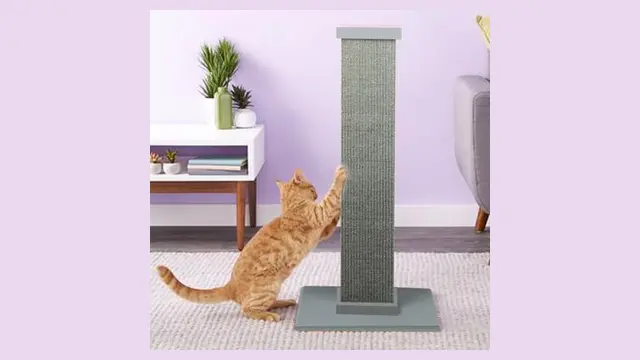
Scratching is one of the few cat behaviors you cannot train away, and trying to is where most owners go wrong. A cat digs its claws into things to stretch the muscles down its back and legs, to strip the worn outer sheaths off its claws, and to leave a mark that is both seen and smelled, because cats carry scent glands in the pads of their paws (ASPCA). None of that is aimed at you, and none of it stops because you are annoyed. You are not going to talk a cat out of scratching. What you can decide is what it sinks its claws into, and the whole job is redirecting the behavior onto something you are glad to give up, then making that target more appealing than the arm of the sofa. Our editors have watched enough couches lose this fight to trust one rule above the rest, redirect the claws, never punish them.
One honest caveat before the how-to. This guide assumes a healthy, settled cat that scratches because scratching is what cats do. If the clawing suddenly ramps up, spreads to new spots, or arrives alongside hiding, over-grooming, or changes at the litter box, treat that as a possible stress or health signal rather than a decorating problem, and read signs your cat is sick before you buy another post. For everyone else, the plan below runs behavior first: understand the drive, give it a better outlet, and protect the furniture while the habit shifts.
Why you cannot cancel scratching
Scratching is a normal, healthy behavior that a cat needs to perform, not a bad habit it picked up. The Ohio State University Indoor Pet Initiative treats an appropriate scratching surface as a core requirement for an indoor cat, in the same bracket as food, water, and a clean box, because a cat with no acceptable place to scratch will use the ones you did not choose. Cats tend to scratch on three cues: right after waking, which is why the claws come out near a favorite napping chair; after a meal or a burst of play; and in prominent, high-traffic spots where the visible mark and the scent do their territorial job. An indoor cat has fewer natural surfaces to work on than one that comes and goes, so if your cat lives inside, the pressure to find a target lands entirely on your furniture unless you supply the alternative. That distinction, and how it shapes enrichment, runs through our look at indoor versus outdoor cats.
Learn what your cat likes to scratch
Before you buy anything, read the evidence your cat has already left on your furniture, because a scratcher only works if it matches the cat's taste in three ways: orientation, texture, and where it sits. Some cats are vertical scratchers that reach up the side of the couch and pull down; others are horizontal, working a rug or the carpet flat on the floor; a few prefer an angled surface. Texture matters just as much. A cat that shreds a woven sofa arm is voting for something coarse and fibrous, while one that goes after a cardboard box wants exactly that. Match the new outlet to what the ruined item is made of and how the cat holds its body while destroying it, and you have solved most of the problem before the post is even out of the packaging.
- Vertical shredder: claws high on the sofa side, curtains, or a door frame. Give it a tall upright post it can stretch up.
- Horizontal digger: works the rug, carpet, or a doormat flat on the ground. Give it a floor pad or an angled ramp.
- Texture tell: whatever it already destroys names the material. Rough weave points to sisal, cardboard points to corrugated cardboard, bare wood points to a log or a bark-wrapped post.
- Location tell: the spot it keeps returning to is the spot that needs an outlet, not a corner you would prefer.
A post they use vs one they ignore
Most scratching posts that get abandoned fail on two things, and neither is price. The first is height. A vertical post has to be tall enough for a full-body stretch with the front paws reaching well up, which in practice means roughly three feet or more, and taller is safer than shorter. A stubby post that makes the cat crouch gets skipped for the couch, which lets it stretch properly. The second is stability. A post that rocks or tips under a firm pull teaches the cat in a single try that this thing is not to be trusted, so a wide, heavy base matters more than the fabric wrapped around the column. Texture is the third lever, and here you follow the cat's vote from the last step: sisal rope or sisal fabric suits most vertical scratchers, corrugated cardboard suits most horizontal ones, and some cats want plain wood. If you would rather compare specific posts, pads, and cat trees, our roundup of the best cat trees and scratchers sorts them by build and use.
About three feet or more for a vertical post, so the cat can reach up and pull through a full stretch instead of crouching.
A wide, weighted base that does not wobble or tip. One shaky post kills a cat's trust in it for good.
Sisal for the vertical shredders, cardboard for the floor diggers, bare wood for the cats that want it. Follow the damage, not the label.
Put the outlet in the path
Where the post stands does as much work as the post itself, and the instinct to hide it in a spare bedroom is exactly backward. The scratcher belongs right next to the furniture that is getting clawed, so the cat meets the good option in the exact spot it already wants to work. Because cats scratch on waking, a second post by the bed or the favorite napping chair catches the morning stretch, and because they scratch to mark busy, prominent places, a post near a doorway or in the middle of a lived-in room outperforms one tucked out of sight. Give a cat more than one outlet spread across the rooms it actually uses, and mix orientations so a vertical option and a horizontal one are both within reach. In a multi-cat home the count matters more, since one confident cat can quietly claim a single post and leave the others with nowhere acceptable to go.
Make the post the better deal
With the right post in the right spot, you make two moves at once: sweeten the new target and dull the old one. To pull the cat over, rub or sprinkle catnip or silvervine on the post, play with a wand toy against it so the claws land there, and reward calm scratching with a treat or praise the moment it happens. To cool off the furniture without any punishment, change how the clawed spot feels: double-sided sticky tape, a loose slipcover, or a sheet of aluminum foil over the exact patch makes it unpleasant to work, and a synthetic feline facial pheromone applied nearby can lower the urge to re-mark the area (ASPCA). The one rule that ties it together: never strip the deterrent and the outlet apart. Put the appealing post right where the ruined spot is, so the cat trades up in place rather than hunting for a new victim across the room.
- Sweeten the post: catnip or silvervine, wand-toy play against it, and a treat the instant the cat uses it.
- Dull the furniture: double-sided tape, foil, or a slipcover over the clawed patch changes a texture cats dislike.
- Lower the marking urge: a synthetic facial pheromone near the old spot can make it feel less like territory to defend (ASPCA).
- Keep them paired: stand the new post beside the covered-up target, then move it a few inches at a time only once the cat has committed to it.
A plain post two feet from the couch beats a handsome one across the house, because a cat scratches where it already is, not where you filed the furniture.
Trim the claws, cap if you must
Even with a post the cat loves, sharp claws do more damage on every surface, so keeping the tips blunt is the quiet half of the job. A nail trim every week or two takes the needle off the ends and cuts down on snags in fabric, and a kitten who gets its paws handled early grows into a cat that barely notices the clippers, which is one more reason to build the routine in from day one, as our guide to bringing home a new kitten lays out. If a cat still targets one irreplaceable thing, soft vinyl nail caps are a humane middle option: glued over the trimmed claws, they blunt the point without removing anything, cause the cat no harm, and simply fall off as the nail grows, so they need replacing every few weeks (ASPCA). Caps and trims are add-ons, not replacements. The cat still needs a real surface to scratch, because blunting the claw does nothing about the drive behind it.
Skip the spray bottle
It is tempting to yell, squirt water, or startle the cat mid-scratch, and it is worth knowing why that reliably backfires. The cat does not connect the scare to the scratching, it connects it to you, so it learns to scratch when you are out of the room rather than to stop. Worse, the stress can spill sideways into hiding, over-grooming, or trouble at the litter box, trading a scratched couch for a genuinely anxious cat. Both the OSU Indoor Pet Initiative and the ASPCA steer owners away from punishment and toward redirection for this reason. You are competing with an instinct, and you win by out-offering it, giving the cat a better place to do what it was always going to do, not by making it afraid of your hands.
Why declawing is not a fix
It is worth being blunt about this, because the name hides what the surgery is. Declawing, or onychectomy, is not an aggressive nail trim. It is the surgical amputation of the last bone of each toe, roughly the equivalent of removing a human finger at the final knuckle (AVMA). The American Association of Feline Practitioners strongly opposes declawing as an elective procedure and points to lasting harms it can leave behind, including chronic pain, an altered way of walking, a tendency to bite instead of scratch, and litter box avoidance once digging in litter hurts (AAFP). The AVMA discourages it outside of a genuine medical need for the cat itself. It is also a moving target in the law: declawing is now banned statewide in New York (2019) and Maryland (2022), across much of Europe, and in a growing list of individual US cities, so before you would even weigh it, confirm what is legal where you live and raise it with your own veterinarian, who in almost every case will send you straight back to the posts, placement, and trims above.
- Offer several scratchers matched to your cat's own orientation and texture (ASPCA)
- Make them tall and heavy-based enough for a full stretch that will not tip
- Stand them next to the clawed furniture, by nap spots, and near doorways
- Draw the cat over with catnip, wand play, and a treat for using the post
- Dull the old target with double-sided tape, foil, or a slipcover, plus a pheromone nearby
- Trim the claws every week or two, with soft nail caps as a temporary backup
- Yelling, squirting water, or startling the cat, which teaches fear of you, not the post (OSU, ASPCA)
- Hiding the only post in a spare room the cat never sets foot in
- Buying a short, wobbly post the cat tries once and writes off
- Pulling the deterrent and the outlet apart, leaving the cat no place to go
- Treating declawing as a shortcut, since it amputates bone and can cause lasting pain (AVMA, AAFP)
- Waving off a sudden scratching spike that may be pointing at stress or illness
Your first week, in order
Run it top to bottom and the couch usually stops paying the price within a couple of weeks. Watch first: note whether your cat scratches up or down, on what texture, and in which spot. Buy to match: a tall, steady post in that orientation and material, plus a horizontal pad if your cat uses both. Place it in the path: right beside the clawed furniture, with extras by the bed and near doorways. Sweeten and dull: catnip and rewards on the post, double-sided tape or foil on the old spot, a pheromone nearby, and keep the two paired. Blunt the tips: trim every week or two, adding soft nail caps if one thing still needs saving. Leave two things off the list: punishment, which just teaches the cat to fear you, and declawing, which amputates bone. Give the instinct a better home and the furniture stops being the only option.
Questions cat owners keep asking
Match it to your cat rather than to your decor. Watch which way your cat scratches: a cat that reaches up the couch wants a tall vertical post, while one that works the rug wants a horizontal pad or an angled ramp. Then match the texture to whatever it already destroys, usually sisal for vertical scratchers and corrugated cardboard for horizontal ones. Two build details decide whether it gets used: a vertical post should be about three feet or taller so the cat can fully stretch, and it needs a wide, heavy base that will not wobble, because one shaky pull convinces a cat to abandon it for good.
Put the post where the scratching already happens, right next to the clawed furniture, not off in a spare room. Make it the better deal with catnip or silvervine, wand-toy play against it, and a treat the moment your cat uses it. At the same time make the couch dull without any punishment: cover the clawed spot with double-sided tape, foil, or a slipcover, and a synthetic feline pheromone nearby can lower the urge to re-mark it (ASPCA). Keep the post and the covered spot together, and only inch the post to a tidier location once your cat has fully committed to it.
Not as a way to stop scratching. Declawing, or onychectomy, is not a nail trim; it is the surgical amputation of the last bone of each toe, comparable to removing a human finger at the final knuckle (AVMA). The American Association of Feline Practitioners strongly opposes it as an elective procedure because of lasting harms like chronic pain, an altered gait, biting, and litter box avoidance, and the AVMA discourages it outside a real medical need for the cat (AAFP, AVMA). It is also banned in a growing list of places, so check your local law. For unwanted scratching, posts, placement, deterrents, trims, and nail caps solve the problem without surgery.
It reduces the damage, not the behavior. A trim every week or two blunts the sharp tips so scratching does less harm and snags less fabric, but the drive to scratch is about stretching, marking, and shedding claw husks, and none of that goes away when the tips are dull. Your cat still needs a real surface to work on. If one particular item is precious, soft vinyl nail caps glued over the trimmed claws add another layer of protection and fall off as the nail grows, but they are a supplement to a good post, never a substitute for one.
A sudden jump in scratching, especially in new spots, is often a response to something that changed. New furniture, a move, a new pet or person, or another cat visible outside the window can all push a cat to mark more territory, and stress or discomfort can drive it too. Start by adding outlets near the newly targeted areas and reducing the trigger where you can, for example blocking the view of an outdoor cat. If the extra scratching comes with hiding, over-grooming, appetite changes, or litter box problems, treat it as a possible health signal and read our guide to signs your cat is sick, then call your veterinarian rather than buying another post.